
More Americans are participating in sports and fitness than ever before. In 2025, 80.5% of Americans ages six and older, approximately 250 million people, participated in at least one tracked activity. That marked seven consecutive years of growth and the highest participation rate SFIA has recorded.
But those gains are not reaching everyone equally.
SFIA is releasing data publicly for the first time showing that participation among Americans who identify as having a disability or impairment declined between 2023 and 2025, even as overall participation increased.
As the United States prepares to host the 2028 and 2034 Paralympic Games, the sports and fitness industry has an opportunity to help change that trajectory. Through SFIA’s 2034WARD Campaign, we can work together to ensure that when people feel inspired to become active, accessible and affordable opportunities are ready to welcome them.
The sports and fitness participation gap is widening
In 2023, 78.8% of all Americans ages six and older participated in at least one tracked sport or fitness activity. Among Americans identifying as having a disability or impairment, the rate was 73.5%.
By 2025, overall participation had increased to 80.5%, while participation among Americans identifying as having a disability or impairment had declined to 72.1%.
The difference widened from 5.3 percentage points to 8.4 percentage points in two years.
Sports and Fitness Participation Rates
The findings give the industry a reason to look more closely at who has opportunities to participate and what would help more people become active. Understanding why participation changed will require further exploration.
Inclusive fitness starts with activities people already enjoy
Expanding participation for people with disabilities includes a wide range of sports, recreation and everyday fitness activities.
SFIA’s 2025 rankings show considerable overlap in the activities Americans participate in most often.
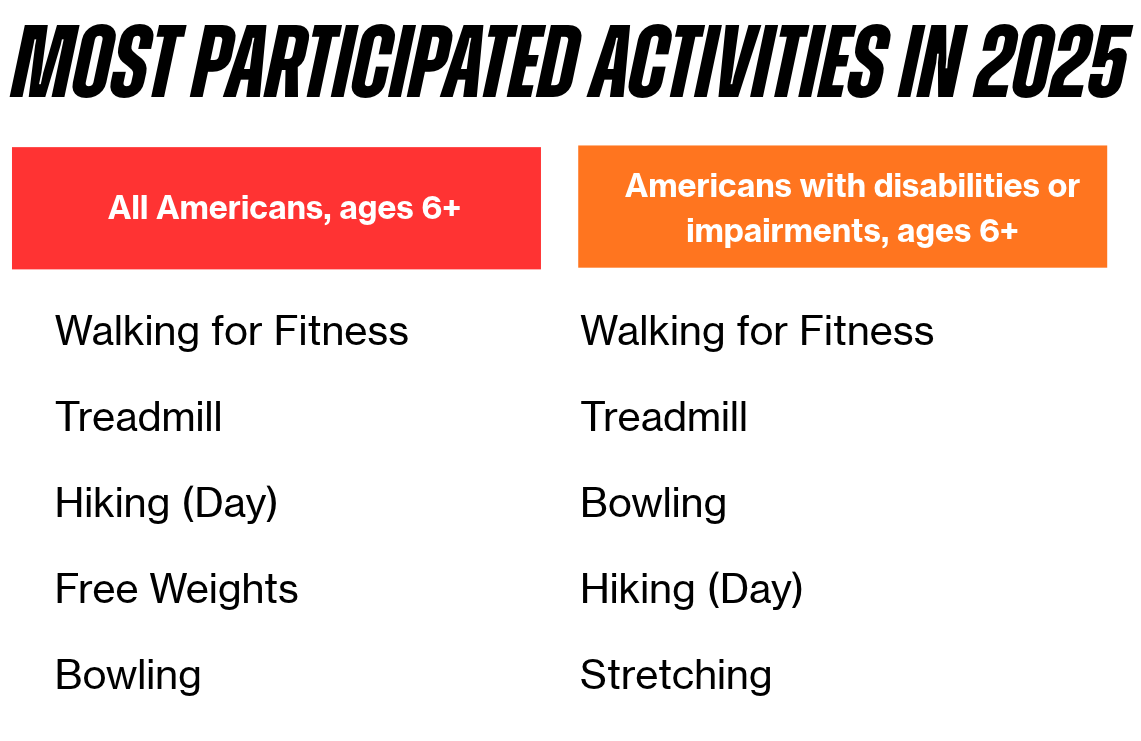
Other ranking differences offer additional context. Stationary cycling ranked ninth among Americans identifying as having a disability or impairment and 14th overall. Running/Jogging ranked 19th in the disability subgroup and sixth overall.
Rankings show relative participation within each population. They do not, on their own, establish preferences or identify barriers.
For companies and program providers, the shared activities offer a useful starting point: how can existing walking, fitness, bowling and outdoor recreation opportunities welcome more participants with disabilities? Alongside adapted sports programs, inclusive fitness and accessible recreation deserve a place in the conversation.
2034WARD Campaign: Meeting inspiration with opportunity
The Los Angeles 2028 Summer Paralympics and Salt Lake City 2034 Winter Paralympics will bring a global spotlight to adapted sport on U.S. soil.
For someone watching, that visibility may spark an interest in trying a new activity or returning to a sport they once enjoyed. Our industry can prepare now to help people take that next step.
SFIA’s 2034WARD Campaign brings the industry together to use this decade of major sporting events to expand sports and fitness participation. Making that growth more inclusive means considering the participant experience well before someone arrives for a first session.
That work can include:
Accessible facilities: Assessing whether people can reach, enter and use the spaces where activity takes place.
Affordable equipment: Exploring ways to make appropriate equipment available for people trying an activity.
Inclusive programs: Working with participants and experienced providers to develop welcoming opportunities at different skill levels.
Community partnerships: Connecting manufacturers, retailers, governing bodies and local organizations with people who know their communities’ needs.
People with disabilities should help shape these decisions. Their experiences can guide organizations toward opportunities that are useful, welcoming and sustainable.
data can help guide the next steps
Participation data show where the industry should ask more questions. Which opportunities are people seeking? Where are programs, facilities or equipment difficult to access? What information would help organizations make the case for investment?
SFIA is inviting industry leaders and the adapted sport community to help identify the research needed to answer those questions and support more inclusive participation.
The coming decade gives our industry a chance to build a lasting participation legacy. When inspiration strikes, opportunity must be there to meet it.
Learn more about the 2034WARD Campaign and connect with SFIA about helping more Americans find their way to play.
About the data: Sources include SFIA participation research for 2023–2025. Figures represent the U.S. population ages six and older. Participation means engaging in at least one tracked activity during the reporting year and does not necessarily indicate regular activity or meeting weekly exercise recommendations. Disability or impairment status is self-identified.